 Vfat
Vfat fees: Swaps, Rewards, and Automation Costs
Vfat fees depend on whether an action swaps tokens, handles rewards, or rebalances a position. The standard schedule charges 0.09% for deposits and withdrawals involving swaps, 0.9% of rewards for manual harvesting or compounding, and different rates for automation. Rebalance charges use position value and the pool's fee tier. Network gas, underlying protocol or swap costs, and optional cover premiums remain separate, so a strategy percentage does not describe the complete transaction cost.
Updated -
Reward value, position value, and network costs
For reward fees, multiply the rewards handled by the applicable rate. For a rebalance, multiply position value by its tier's rate. Express the resulting amounts on a consistent token or currency basis before combining costs. Adding the percentages alone mixes different denominators. Network gas and any underlying protocol or swap costs sit outside the Vfat strategy schedule, even when an action has a zero strategy charge.
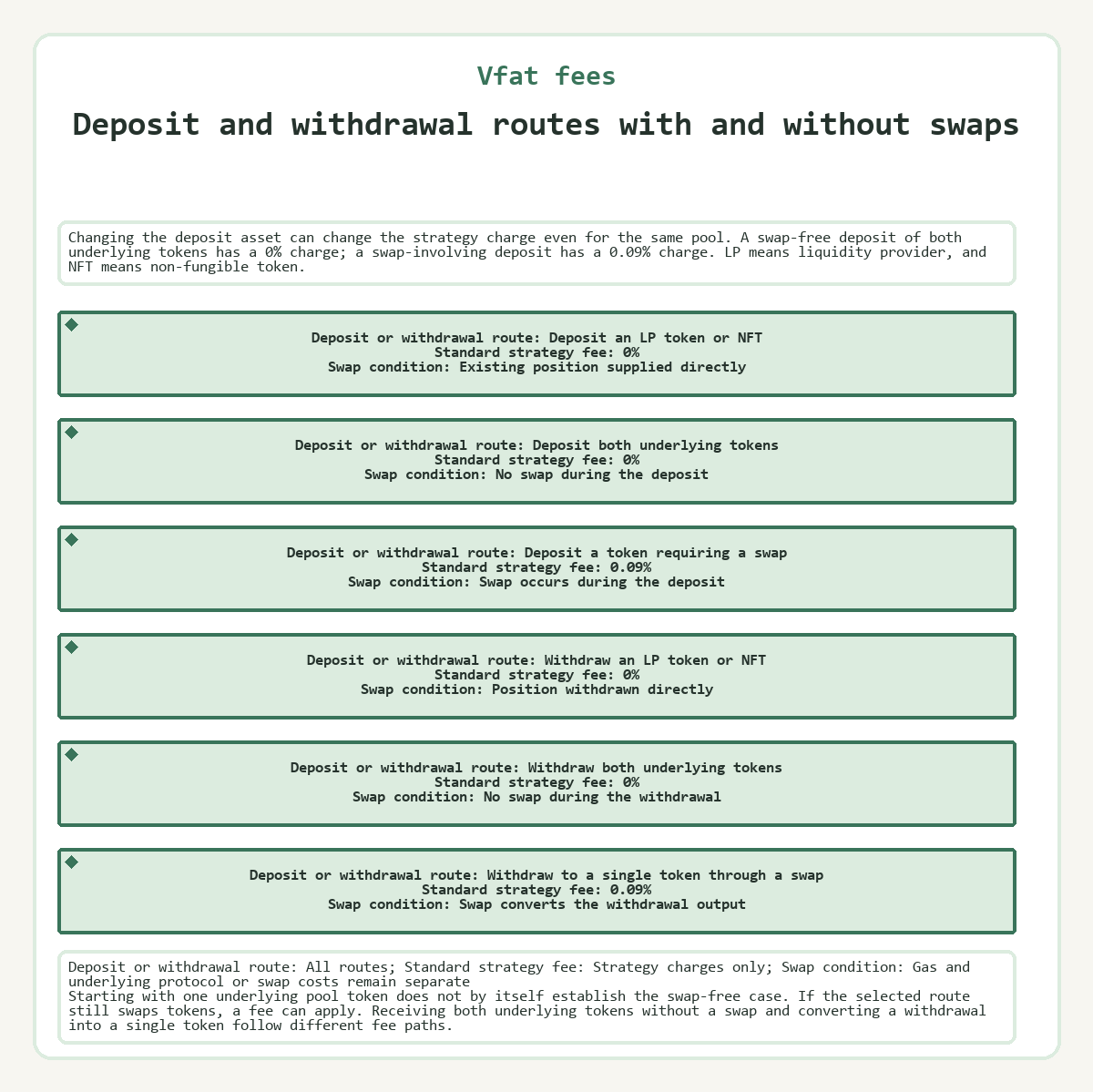
Deposit and withdrawal routes with and without swaps
Changing the deposit asset can change the strategy charge even for the same pool. A swap-free deposit of both underlying tokens has a 0% charge; a swap-involving deposit has a 0.09% charge. LP means liquidity provider, and NFT means non-fungible token.
| Deposit or withdrawal route | Standard strategy fee | Swap condition |
|---|---|---|
| Deposit an LP token or NFT | 0% | Existing position supplied directly |
| Deposit both underlying tokens | 0% | No swap during the deposit |
| Deposit a token requiring a swap | 0.09% | Swap occurs during the deposit |
| Withdraw an LP token or NFT | 0% | Position withdrawn directly |
| Withdraw both underlying tokens | 0% | No swap during the withdrawal |
| Withdraw to a single token through a swap | 0.09% | Swap converts the withdrawal output |
| All routes | Strategy charges only | Gas and underlying protocol or swap costs remain separate |
Starting with one underlying pool token does not by itself establish the swap-free case. If the selected route still swaps tokens, a fee can apply. Receiving both underlying tokens without a swap and converting a withdrawal into a single token follow different fee paths.
Harvest and compound charges on rewards
Reward handling has its own percentage base, so manual and automated charges need to be compared against the rewards processed by each action.
Manual reward actions
Manual Harvest claims rewards, and manual Compound reinvests them. Each carries a standard 0.9% fee on rewards. A reward charge and a position-value rebalance charge can therefore apply to different amounts within an operation involving both actions.
Automated reward actions
Auto-Harvest charges 1.2% of rewards in the standard path. The standard Auto-Compound fee is 1.8% of rewards. The automated rate replaces the corresponding manual reward rate for that path. Network and route costs still need separate consideration.
Rebalance tiers and separate reward charges
Manual rebalancing and Auto-Rebalance share a position-value fee selected by the underlying pool's swap-fee tier. Reward processing can add a separate charge.
Pool fee brackets
A pool fee of at most 0.05% corresponds to a 0.01% rebalance charge on position value. Above 0.05% and up to 0.3%, the position charge is 0.03%. Higher-fee pools use 0.05% of position value. The pool's swap-fee percentage selects the bracket; it is a separate rate from the rebalance charge.
Rewards collected during rebalancing
Compound reinvests rewards into the replacement position. Harvest sends the original reward tokens to your wallet, while Swap & harvest converts them into one selected token first. Any applicable harvest or compound fee remains separate from the position-value charge. The fees shown with the selected settings identify the reward-handling path.
Auto-Exit charges and execution prices
Auto-Exit uses the standard withdrawal fee plus any applicable charge on collected rewards. Its selected output can affect the withdrawal cost when conversion requires a swap. The configured trigger marks eligibility without fixing the execution price. The eventual proceeds depend on the executed route and applicable costs, so a trigger price cannot establish the amount received after an exit.
Fee-funded automation and reward thresholds
Normal automation waits until its fee revenue can cover gas and the action's other conditions hold. A saved configuration alone does not establish a queued or completed execution.
Auto-Harvest checks for at least $50 of rewards before attempting a harvest. That minimum alone does not fund every transaction. Higher gas costs can require a larger reward threshold. Eligible prepaid gas can address the funding shortfall, but the $50 reward minimum and strategy fee still apply.
Auto-Compound estimates its reward threshold from position size, APR, and transaction cost. APR means annual percentage rate. Under normal fee-funded execution, rewards must meet the estimated threshold and the automation fee must cover gas. The estimate aims to improve returns after gas; it does not establish the best possible compounding interval.
Auto-Rebalance has no fixed dollar minimum across chains. Gas prices, the pool fee tier, and the transaction determine the estimated required position size. Without an enabled gas account, the deposit warning shows funding estimates for selected Auto-Rebalance or Auto-Exit actions. If both are selected, it uses the higher requirement.
Those position-size estimates are informational and do not block deposits. A scheduled retry can coexist with a reported funding failure; neither establishes a completed run.
Prepaid gas limits on each Sickle and chain
Prepaid automation gas is an optional native-token balance for a Sickle, the smart contract wallet used for positions on a particular chain.
Eligibility and activation
Eligible automation can use the prepaid balance when fee revenue cannot cover gas. Availability depends on the Sickle and chain's contract configuration. Funding the balance alone does not enable charging: prepaid gas requires its own activation and wallet confirmations. Any required automation enablement or upgrade comes before prepaid activation.
Native-token spending limits
The saved per-operation cap uses the chain's native-token units, even when an approximate fiat value appears beside it. The balance itself can also serve as the spending limit. Prepaying gas leaves strategy fees in place. Automated runs do not debit the connected wallet's native-token balance each time.
Intervals between prepaid reward charges
A minimum interval can limit prepaid harvest and compound charges. For grouped Auto-Compound setups, this setting is shared across setups on the same Sickle and chain. It controls spending frequency without scheduling an execution. Automation triggers, permissions, and transaction limits continue to apply.
Slippage and price impact alongside strategy charges
Slippage and price impact affect the swap component of a rebalance alongside its listed strategy charge. Slippage tolerance limits movement between the quoted and executed swap price. Price impact is the aggregator-estimated price difference between the sold and bought assets. Auto-Rebalance skips and retries routes exceeding either limit. A smaller nominal strategy fee does not resolve an unacceptable execution price.
Yield earnings and personal fee estimates
The Yield Earnings figure covers the displayed deposit mode across all its liquidity, without identifying your personal reward balance. The same pool can offer staked and unstaked modes with different income. Pool-wide TVL, meaning total value locked, measures the entire pool. Applying a personal strategy rate to either aggregate would calculate a charge on the wrong amount.
Earnings combines swap-fee income and token incentives for the selected period. Swap fees use that period's history when available, while token rewards use the current rate projected over the duration. If swap-fee history is unavailable but rewards are known, an asterisk can mark a rewards-only estimate. That partial figure cannot establish complete income or the costs of handling a particular position's rewards.
Contract scope and optional cover premiums
Available strategies differ by chain and contract version, and the applicable transaction fees follow the chosen route. The standard schedule describes strategy charges; it does not establish an all-inclusive price for every swap or bridge action. Transaction details matter when comparing routes with different conversions or underlying protocol costs.
Optional cover adds a premium outside the standard strategy charges. Premiums are priced separately at purchase time for Bundled Protocol Cover.
What readers ask about Vfat fees
Why can topping up a gas account leave a prepaid charge blocked?
A per-operation cap can block prepaid charging even after the balance receives more funds. The available balance and saved charge limit are separate constraints, and adding funds does not raise that limit. The automation status distinguishes a low-balance problem from a charge-limit problem. Prepaid activation must also be complete before automation can use the funded account.
How can an NFT compound transaction show fees from other positions?
An NFT compound record can include transaction totals covering other positions or wallets in the same batch. The destination's History shows completed runs and recorded reward-source attribution. Expanded totals may extend beyond the NFT being viewed. A completed destination run also does not establish that every connected source contributed rewards, so participation alone cannot determine its share of the recorded costs.
Will a failed cross-position Auto-Compound setup require another deposit?
A confirmed deposit remains confirmed if a later Auto-Compound setup step fails. Routing rewards into another eligible position on the same chain can require separate setup transactions after the deposit. The failed setup step can be retried without depositing again. Confirmed settings are reloaded, and already-applied changes are skipped on retry; routing becomes active only after setup and required permissions are complete.
When is the fiat value of a prepaid compound charge calculated?
Auto-Compound history values a prepaid gas charge at the current price of the chain's native token. Its displayed fiat equivalent can therefore change with that price even though the recorded native-token charge has not changed. A later valuation is not a second deduction from the prepaid balance.
What determines the wallet confirmations needed for automation setup?
The Sickle's existing setup determines which approvals, action permissions, or migration transactions automation requires. These requirements apply on the selected chain, alongside the position's saved settings. Cross-position compounding can require additional setup transactions. A changed Auto-Exit delay can also require a separate transaction. There is no single confirmation count that describes every setup, so initial setup costs vary with the required transactions.
Which rewards contribute to a grouped Auto-Compound fee base?
Grouped Auto-Compound can combine farm rewards and NFT trading fees before applying its reward fee. Normal compounding also includes eligible unassigned provider rewards, such as Merkl. A provider claim can cover several positions within one Sickle on the same chain. Existing provider assignments stay with their chosen destination, so another position's automation does not automatically receive those assigned rewards.
Does the Auto-Harvest frequency estimate set a recurring fee schedule?
Auto-Harvest's reward frequency estimate describes accumulation time from zero at the current harvestable reward rate, without setting a billing schedule. Existing rewards can shorten the initial wait. Reward rates, token prices, gas costs, automation checks, and funding can change the timing. A prepaid minimum interval limits charges but does not promise a harvest or compound when the interval ends.